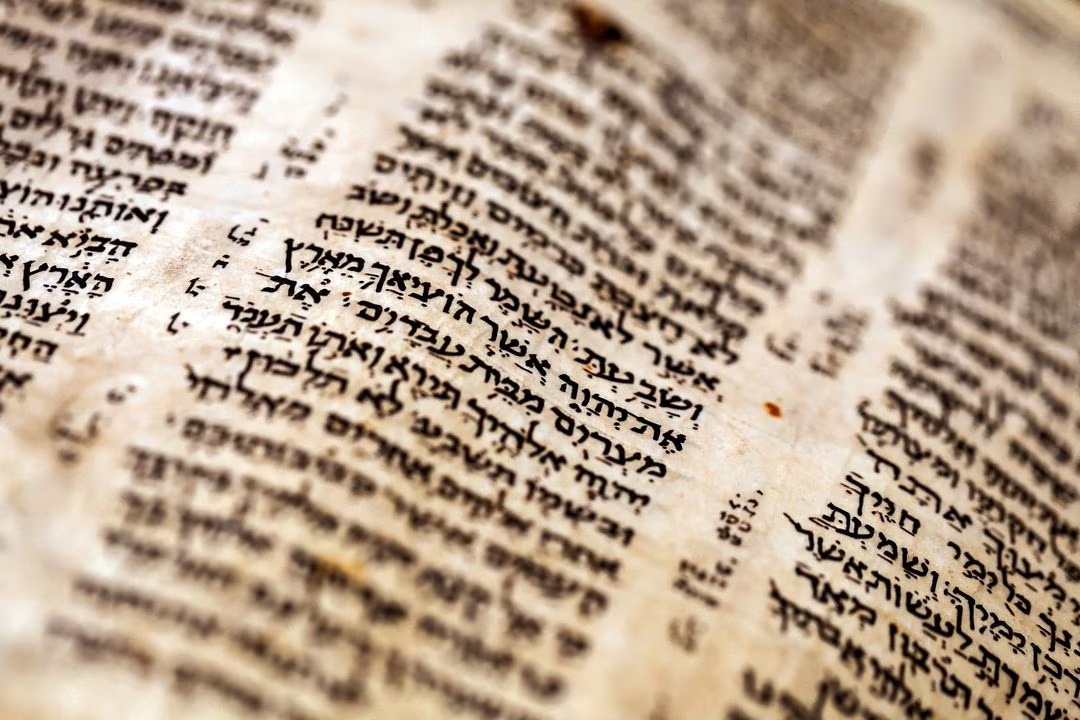
Earliest Hebrew Bible Sells For $38M at Sotheby’s Auction

Sotheby’s auction house sold a 1,100-year-old Hebrew Bible for $38 million in New York. It’s one of the world’s oldest surviving biblical manuscripts and brought the second-most highest price for a historical document at auction.
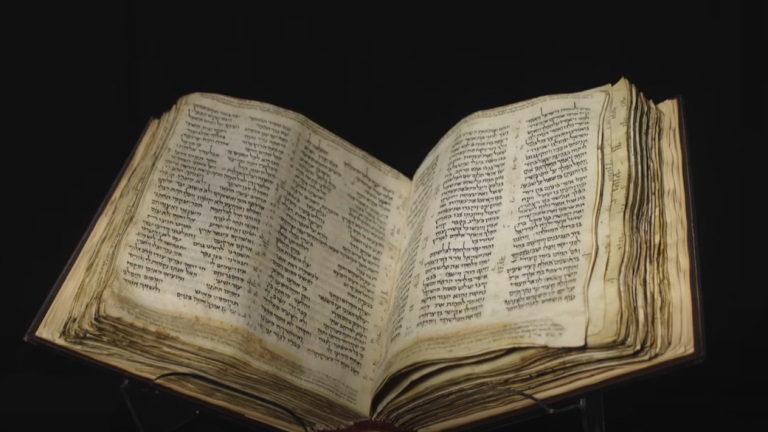
The 26-pound book, whose five-inch stack of parchment has 396 pages, sold after a five-minute battle between two bidders competing over the phone. According to the Wall Street Journal, the final price, including Sotheby’s fees, fell short of breaking the record held by a $43.2 million copy of the U.S. Constitution bought two years ago by billionaire Ken Griffin. In 1994, Leonardo da Vinci’s Codex Leicester sold for $31 million or around $60 million in today’s dollars.

In a statement, Sotheby’s said the Codex Sasson, a leather-bound, handwritten volume with an almost complete Hebrew Bible, was purchased by former U.S. Ambassador to Romania Alfred H. Moses for the American Friends of ANU and donated to the ANU Museum of the Jewish People in Tel Aviv, where it’ll join the museum’s collection.
Read more

Why I believe the Bible

The most important question any Christian should be able to answer is why we choose to believe the Bible. The standard fallback answer given by many is “I was raised that way”. The problem with this sentiment is that many things that we were raised to believe turned out to be false. For example, our parents told us if we went outside with wet hair, we would catch a cold. As adults we learned that a cold is a virus.

Another answer often given is “I tried the Bible and it worked for me.” This answer certainly opens up a huge logical hole when based on a personal experience. Malcolm X changed his life, he tried the Nation of Islam and it “worked for him”. He later denounced his beliefs in Islam and was killed for it. What about the changed life of a Mormon or a Jehovah Witness.

Our response, as Christians, should sound something like this…

“I choose to believe the Bible because it is a reliable collection of historical documents, written by eyewitnesses during the lifetime of other eyewitnesses, reporting supernatural events that took place in fulfillment of specific prophecies and claimed their writings are Divine in nature and not of human origin.”

Dr. Voddie T. Baucham, Jr., Dean of the School of Divinity at African Christian University in Lusaka, Zambia

Read more

What Are the Five Solas?

The five solas were not exactly Reformation slogans, but they serve as a good summary of the Reformed faith. Neither Martin Luther nor John Calvin nor any other Protestant Reformer summarized his teachings in a tidy list including Scripture alone, Christ alone, faith alone, grace alone, to the glory of God alone. Taking flight in the nineteenth and twentieth centuries, this fivefold summary became the shorthand version of what is known as Reformed theology. While this description of the Reformed faith came later, it still captures well the core of the gospel in all its graciousness and Christ-centeredness, just as it is revealed in the Scriptures. These five solas show the glory of God’s gracious way of salvation in a way that sets the tone for true theology, resounding in how we think and live in this world.

Read more

GAFCON 2023 – Kigali, Rwanda

The Global Anglican Communion meets for the 4th time since 2009. Conservative primates gathered in Kigali and withdrew their recognition of Archbishop of Canterbury, Justin Welby, as the “first among equals.” The chair of St Augustine is now empty, as far as leaders representing an estimated 85 percent of the Anglican Communion are concerned. The … Read more

How to calculate the date of Easter in the Western Church

Easter Sunday falls on a different Sunday every year. Using the 1928 Book of Common Prayer of the Episcopal Church, Easter falls on the first Sunday, between March 21st and April 19th, after the Paschal full Moon that occurs on or after the spring equinox. If the full moon lands on a Sunday, then Easter is the following Sunday

The date is fixed in accordance with an ancient ecclesiastical computation, and does not always correspond to the astronomical equinox. The Metonic cycle of 19 years is one in which the phases of the Moon repeat exactly. It is thus possible to have a 19-year cycle for the dates of full or new Moon. In the Julian calendar this 19-year cycle can be fairly easily translated into a date for Easter.

The date of the Paschal Full Moon, used to determine the date of Easter, is based on mathematical approximations following a 19-year cycle called the Metonic cycle.

March 21 is the Church’s date of the March equinox, regardless of the time zone, while the actual date of the equinox varies between March 19 and March 22, and the date depends on the time zone.

In today’s Gregorian calendar the calculation is complicated by the definition of which century years are leap years. These leap years mess up the simple Metonic cycle by altering the number of days in different periods of 19 years.

On page lii and liii of the 1928 BCP, you can find the calculation for determining when Easter Sunday is. It requires the following steps:

  1. Find the Golden number or “Prime”
  2. Find the Sunday (Dominical) Letter
  3. Determine Easter Sunday on Calendar with item # 1,2

Read more

World Watch List – Christian Persecution

More than 360m Christians suffer high levels of persecution and discrimination for their faith.

In the past year, the persecution of Christians has not only increased, but it has also spread to more corners of the globe – with incidents occurring on every continent, according to a new report.

The advocacy group Open Doors USA recently released the latest edition of its annual World Watch List, which ranks countries based on the treatment of their Christian populations. The group said the increase in incidents considered persecution was alarming and only getting worse.

“It is appalling that Open Doors has to report that persecution has increased again in 2016 and we are still at the worst levels of persecution in modern times,” David Curry, president and CEO of Open Doors USA, “The spread of persecution has gotten worse, now hitting nearly every continent in the world. There were 23 Christians killed in Mexico specifically because of their faith.”

Read more